Ground Verdict, battery site screening
NSW battery site screening in a day Screen a site free
Battery site screening · New South Wales

Know if a site is worth chasing before you spend a dollar on it.

Send us a lot and DP or a map pin. In about a day you get a clear verdict on that NSW land for a grid battery: grid, competition, vegetation, heritage, neighbours, approvals and rough costs, all from public NSW and federal government data.

Get your first site screened free See an example

No obligation. Your sites stay confidential: we never share, publish or reuse the locations you send us.

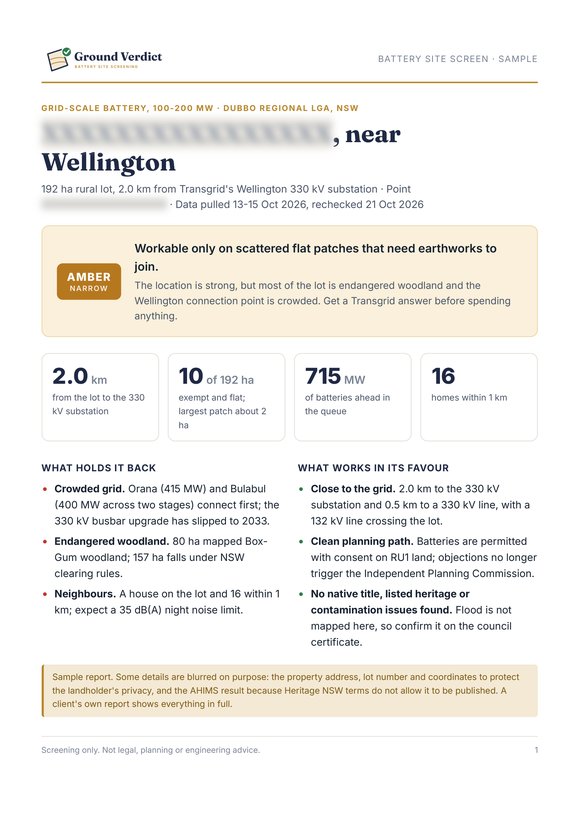
AMBER
Workable only on small flat patches Strong location, crowded grid, mostly endangered woodland
2.0 km
from the lot to a 330 kV substation
10 of 192 ha
exempt and flat, in patches
Grid capacityPROBLEM
Native vegetationPROBLEM
Nearby homes and noiseCAUTION
Native titleCLEAR
FloodNOT MAPPED
Table 1 Example verdict, with five of the 18 scorecard checks. Sample lot near Wellington, NSW.
Constraint map Sample report, page 2
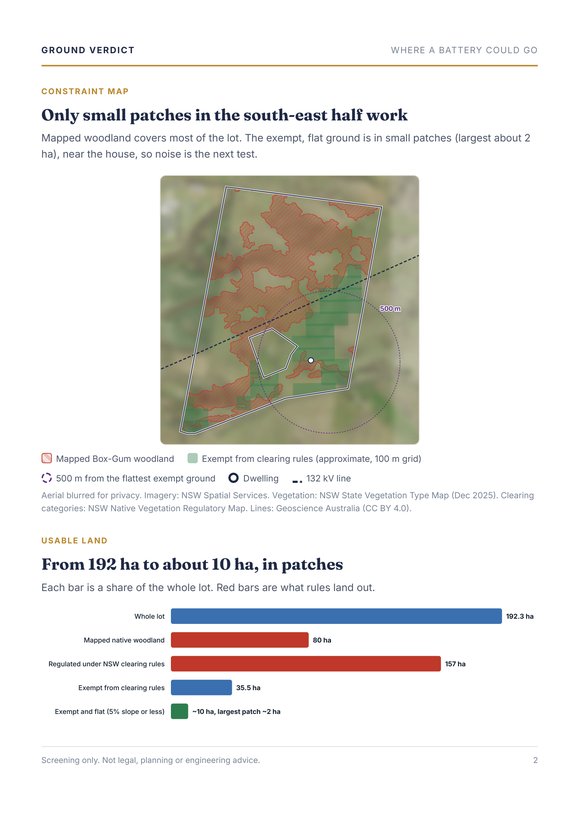
Constraint map of the 192 ha sample lot: mapped Box-Gum woodland covers most of the lot; the exempt, flat ground sits in small patches in the south-east half near the dwelling, with a 500 m ring around the flattest ground and a 132 kV line crossing the lot.
Mapped Box-Gum woodland Exempt from clearing rules (100 m grid) 500 m from the flattest exempt ground Dwelling 132 kV line
Fig. 1 Only small patches work. Mapped woodland covers most of the lot; the exempt, flat ground is in patches of about 2 ha near the house. Aerial blurred for privacy. Imagery: NSW Spatial Services. Vegetation: NSW State Vegetation Type Map (Dec 2025). Clearing categories: NSW Native Vegetation Regulatory Map. Lines: Geoscience Australia (CC BY 4.0).
All of NSW, including its busiest battery hubs New England Central-West Orana Southern Tablelands Hunter Wagga Wagga Riverina
01 A real example

192 hectares that looked perfect. About 10 that worked.

We screened a farm beside a major substation near Wellington, NSW. On a map it was ideal. The report found most of it was mapped endangered woodland, the grid was crowded with two large batteries ahead, and only about 10 hectares of scattered flat patches could realistically host a battery.

That's the kind of surprise we catch on day one, not month six.

Usable land, hectares
Whole lot192 ha
Regulated under clearing rules157 ha
Mapped endangered woodland80 ha
Exempt from clearing rules35.5 ha
Exempt and flat enough~10 ha, in patches
Fig. 2 From 192 ha to about 10 ha, in patches of about 2 ha. Each bar is a share of the whole lot. Red bars are what rules land out.
02 The problem

Land that looks perfect on a map often isn't.

Developers usually find the deal-breakers months in, after paying for options, consultants and a grid connection enquiry that can cost around $50,000.

2.1Protected bushEndangered woodland that can't be cleared, or costs a fortune to offset.
2.2A jammed gridOther batteries already queued at the same substation.
2.3NeighboursHomes close enough that noise limits rule out the design.
2.4Someone else's rightsMining licences, land claims or easements over the lot.
03 How it works

Three steps, about a day.

Think of it as a building inspection, but for land before you turn it into a battery site.

  1. Step 1

    Send the site

    A lot and DP, an address or a map pin, and the battery size you have in mind.

  2. Step 2

    We check it

    We pull dozens of government and market datasets for that land and read them together, so nothing gets missed between specialists.

  3. Step 3

    You get a verdict

    A short, visual report: green, amber or red, the problems that matter, rough costs, and the next calls to make.

04 Where we fit

Not another project map. A verdict on one piece of land.

Project maps and trackers are great for seeing what's being built and where the lines run. Ground Verdict answers the question that comes next: should you chase this exact lot, and what would stop it?

Project maps and trackers

  • Who is building what, and at what stage
  • Where substations and transmission lines run
  • Aerial imagery and project boundaries
  • A wide view across a region or the country

"What's happening around here?"

Ground Verdict

  • A clear green, amber or red verdict on your specific lot
  • The deal-breakers on that land: protected vegetation and clearing rules, threatened species, heritage, nearby homes and noise, mining titles, native title, flood and bushfire
  • How congested the connection point really is, and who is ahead of you
  • The likely approval pathway and timeline, and rough costs from connection to offsets
  • The next calls to make, in order

"Should we chase this exact site?"

Use both: a map to spot an area, then Ground Verdict to check the lot before spending on options, consultants or a connection enquiry.

05 What we check

Everything that kills a site, in one place.

Every finding links back to its public source, so your team can verify it.

5.1GridDistance to substations and lines, competing batteries in the queue, congestion history and loss factors.
5.2Land and planningLot boundaries, zoning, planning pathway, land value and road access for heavy loads.
5.3EnvironmentMapped native vegetation, clearing rules, threatened species, koala habitat and offset costs.
5.4Heritage and titleNative title, listed heritage, Aboriginal heritage searches, mining titles and Crown land.
5.5Neighbours and communityHomes nearby, likely noise limits, objections to nearby projects and council benefit schemes.
5.6Hazards, time and moneyBushfire, flood, fire history, approval timelines and rough build and connection costs.
06 Inside the report

What you actually get.

An 8-page report built for a busy development team: the answer on page one, the evidence behind it, and every source listed.
Report page 1: verdict and key numbers
Page 1The verdictGreen, amber or red, the key numbers and what holds the site back.
Report page 2: constraint map
Page 2Constraint mapWhere a battery could actually go, and how much land is really usable.
Report page 3: scorecard
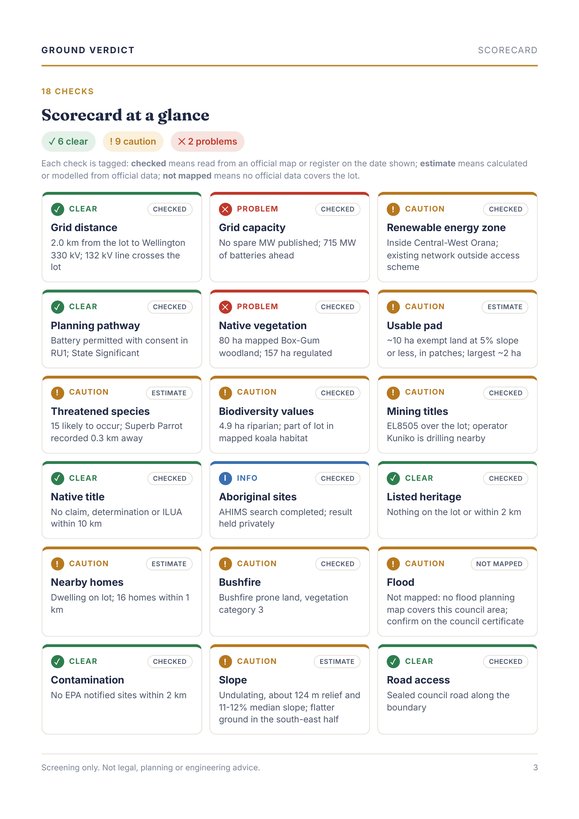
Page 318-check scorecardEvery deal-breaker at a glance, colour-coded.
Report page 6: rough costs and what would turn it green
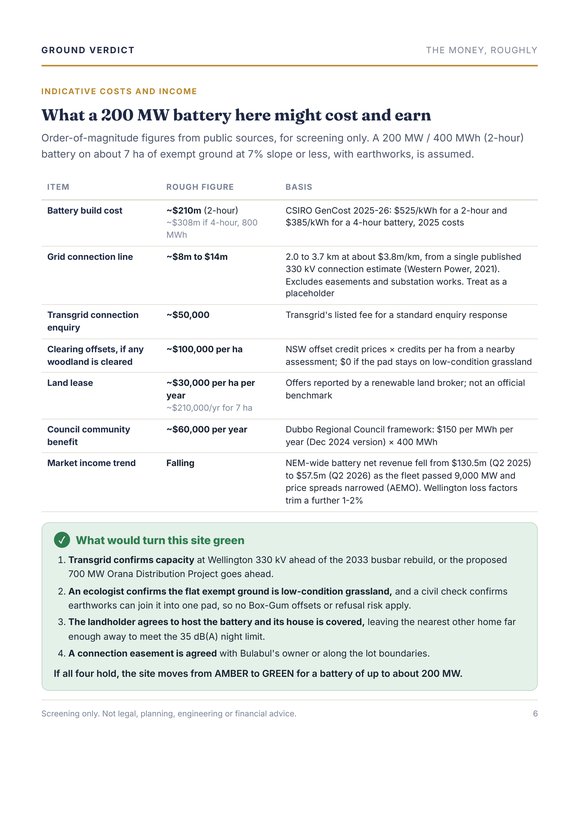
Page 6Money and next stepsRough costs, and exactly what would turn the site green.

Sample shown with the landholder's details blurred.

Get the full sample report
07 Pilot · Limited places

Need sites, not just checks?

We're piloting substation shortlists: we screen every lot near a substation you're targeting and rank the best ones, so your team starts with the strongest land instead of a blank map. Limited places for early partners.

Ask about a shortlist
08 Pricing

Your first site is free. After that, simple prices.

A connection enquiry alone can cost around $50,000. One report that rules out a bad site early pays for itself many times over.

First site

Site screen

Free

Your first report, no obligation. We just ask for honest feedback.

Per site

Site screen

A$2,950

One lot, verdict in about a day. The full 8-page report.

5-pack

Five site screens

A$11,950

About A$2,390 a site. Use them over 12 months.

Pilot

Substation shortlist

From A$9,500

Every lot near one substation, screened and ranked.

Prices in Australian dollars.

09 First site free

Send us a site you're looking at.

Tell us about the site and we'll send your report, then ask for honest feedback in return. Asking for the sample report or a shortlist? Use the same form.

Your sites stay confidential. We never share, publish or reuse the locations you send us.

Prefer email? Write to hello@groundverdict.com